Monday, February 1, 2021

Google to pay $2.59 million to settle allegations of discrimination

Google has agreed to pay $2.59 million to more than 5,500 current employees and former job applicants as part of a settlement with the U.S. Department of Labor over allegations of systemic discrimination as it relates to compensation and hiring. Google has also agreed to reserve $250,000 a year for the next five years to address any potential pay equity adjustments that may come up. That brings Google’s total financial commitment to $3.8 million — a drop in the bucket for the company, whose parent company Alphabet has a market cap of $1.28 trillion.

The settlement comes after the DOL’s Office of Federal Contract Compliance Programs found pay disparities affecting female software engineers at Google’s offices in Mountain View, as well as in offices in Seattle and Kirkland, Washington. The OFCCP also found differences in hiring rates that “disadvantaged female and Asian applicants” for engineers roles at Google’s locations in San Francisco, Sunnyvale and Kirkland. The OFCCP’s evaluation covered Sept. 1, 2014 through Aug. 31, 2017.

As part of the settlement, Google has agreed to pay $1.35 million in back pay and interest to 2,565 female software engineers at the company ($527.50 per employee), and $1.25 million in back pay and interest to 1,757 women and 1,219 Asian applicants for software engineering roles they were not hired for ($414 per person).

Lastly, Google will reserve $1.25 million of the money to go toward pay-equity adjustments for the next five years for U.S. engineers at Google’s Mountain View, Kirkland, Seattle and New York offices.

“We believe everyone should be paid based upon the work they do, not who they are, and invest heavily to make our hiring and compensation processes fair and unbiased,” a Google spokesperson said in a statement to TechCrunch. “For the past eight years, we have run annual internal pay equity analysis to identify and address any discrepancies. We’re pleased to have resolved this matter related to allegations from the 2014-2017 audits and remain committed to diversity and equity and to supporting our people in a way that allows them to do their best work.”

“The U.S. Department of Labor acknowledges Google’s willingness to engage in settlement discussions and reach an early resolution,” Office of Federal Contract Compliance Programs Regional Director Jane Suhr said in a press release. “The technology industry continues to be one of the region’s largest and fastest growing employers. Regardless of how complex or the size of the workforce, we remain committed to enforcing equal opportunity laws to ensure non-discrimination and equity in the workforce.”


from TechCrunch https://ift.tt/2YDCaPa

Former Asana employees want to take on Discord with a positive platform for creator communities

In a creator-economy world, if you’re only as good as your last YouTube video, then your next YouTube video had better be bigger and louder than the last.

Vibely, a new startup co-founded by Asana alumni Teri Yu and Theresa Lee, wants to turn the constant, and often exhausting, beast of content creation on its head. The startup has created a premium, creator-controlled community platform that allows fans to gather and be monetized in new ways, beyond what is possible on YouTube or TikTok.

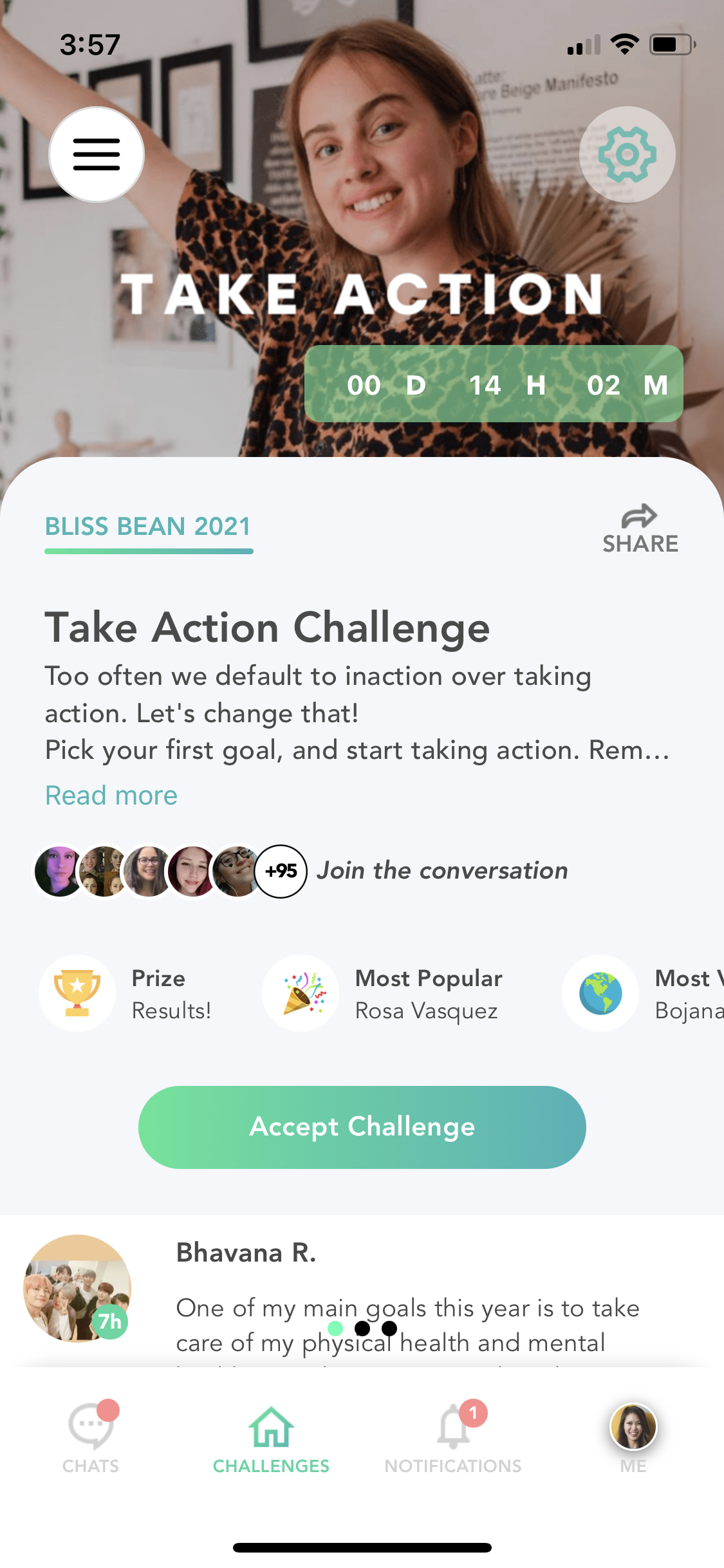
The core of Vibely, and what the co-founders hope will keep users coming back, is the ability to let any creator make a challenge for their fans to enjoy. For example, a creator whose brand evokes thoughtfulness could ask fans to sketch out their personal growth goals or take action around a new year’s resolution everyday. Or a fitness influencer could motivate fans to work out for a sprint of days.

“Most people in the creator economy are thinking about how to immediately monetize and get that instant gratification of like money here,” Yu said, which is why creators sell merchandise or hop on Cameo. “We’re focusing on long-term strategic communities.” Yu describes her startup’s shift as a mindset change, from a linear relationship between creators and fans to a multi-directional relationship between fans, superfans, new fans and creators.

Image Credits: Vibely

Vibely’s pitch is two-fold. For fans, the platform gives them a chance to chat with other fans from around the world. It also lets fans participate in community challenges and have a place to plan virtual hangouts over shared love for makeup or dance. The startup helps creators simultaneously, by giving them a one-stop shop to announce plans, do call to actions and create an ambassador program. It lets the “creator scale their time and have a multi-directional relationship with the community under or beneath them.”

Notably, Vibely is trying to be different from Patreon or OnlyFans, which is basically paywalled content for fans. Vibely doesn’t need creators to post more content, it just needs them to pop into a premium community and interact with fans in a meaningful way.

The startup is formalizing a sporadic daily occurrence: When a creator posts content, their comment sections in YouTube, Instagram and TikTok light up with fans discussing every detail you can imagine, from a suggestive hair flip to if that background poster has a hidden message. Creators often pop in to respond to a spicy thread or a random compliment, which incentivizes fans to keep swarming the content section.

The startup has spent little on customer acquisition cost and relied heavily on word of mouth. In December, Vibely launched a part-in-person, part-virtual creator house to pair top TikTok creators with their followers, generating some buzz. In 2020, Vibely had more than 600 communities with 392,000 messages sent and 37,000 challenges completed. Creators include Lavendaire, with 1.3 million YouTube subscribers and Rowena Tsai, who has 520,000 subscribers.

Yu says that there is one day where Kim Kardashian might have a community on the platform, but the main “bread and butter” of Vibely is searching for creators who represent a true interest, value or belief system. This can be a book influencer or a religious creator, for example.

“[Creators] are controlling their own destiny,” Yu said. “On Instagram or Facebook, you might create content but the algorithm decides at the end of the day whether or not your audience sees it. With Vibely, they have 100% control since this is their community.” The startup is planning to make money through membership dues and in-app mechanics like social currencies and rewards.

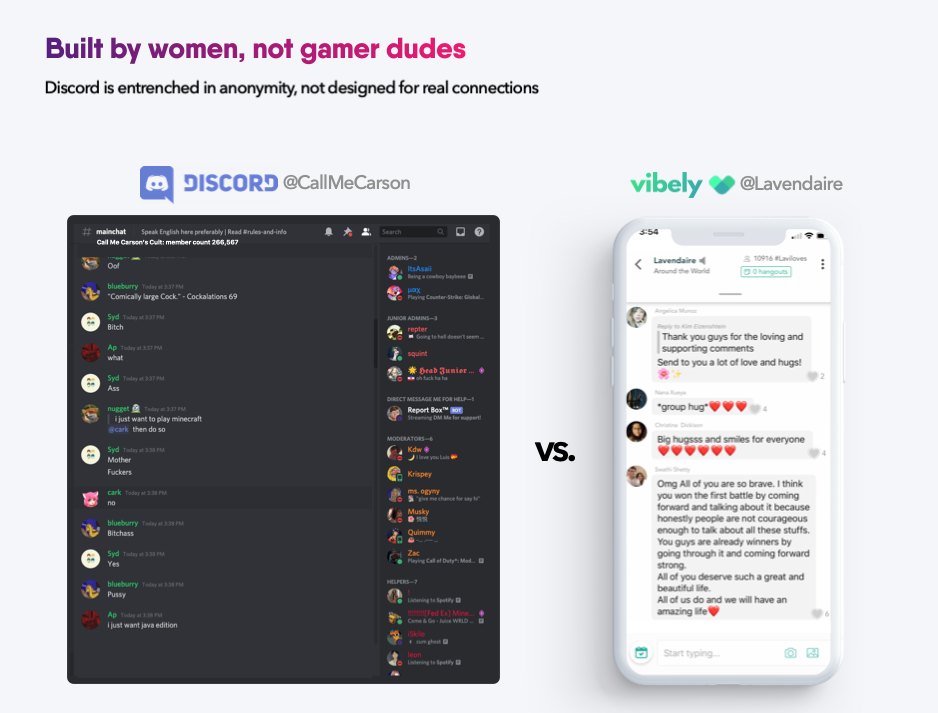
Vibely’s moonshot goal is to be a more positive, and supportive, Discord, a platform used by gamer communities across the world. So far, Yu says that less than .1% of Vibely users have been flagged by other users, although notably would not share total user numbers. There is also an ambassador program that appoints a user to oversee a community, as well as a global community manager on the team.

“The ceiling of where [Discord] can support is really only going to be gamers,” she said. “But creators want to protect their brand right now and make sure people have a positive experience,” so they are looking for another place to set up.

Image Credits: Vibely

While moderation is apparently going well so far, Vibely will most certainly encounter problems as more and more users join its platform. In the world of challenges, craze and hype led by fanatics could potentially become harmful if someone takes it too far. While Vibely aims to be a judgement-free zone for people to connect around the world, scale has a uniquely pessimistic way of forking that from time to time. Some consumer apps have responded to this truth by aggressively hiring on-staff moderators, but that too can become grueling work.

To hit the ground running, Vibely announced today that it has raised $2 million in seed financing from backers including Steve Chen, the co-founder of YouTube; Justin Rosenstein, the co-founder of Asana and co-creator of Netflix’s “Social Dilemma” documentary; Scott Heiferman, the co-founder of Meetup; Turner Novak, formerly an investor at Gelt, and more.


from TechCrunch https://ift.tt/3tcaAqB

Basic security best-practices for your web app & server

submitted by /u/palebt
[link] [comments]

from programming https://ift.tt/2L7ImvM

Speeding up Vimeo's tests with MySQL simulation

submitted by /u/muglug
[link] [comments]

from programming https://ift.tt/2Lagc3r

Requesting performance isolation with the Origin-Agent-Cluster header

submitted by /u/feross
[link] [comments]

from programming https://ift.tt/3alUd28

Smooth Camera Movements | C++ 3D Game Tutorial Series #27

submitted by /u/PardDev
[link] [comments]

from programming https://ift.tt/36AgXdD

Facebook Software Engineer teaching free live class on Fundamentals of Programming

submitted by /u/sorusch
[link] [comments]

from programming https://ift.tt/3j9hZ5k